House Of Wax Movies – A Full Body Wax Treatment Cinemax
No matter how you look at it, wax dolls always have a spooky side. We can quickly think of the reasons for their frightening side: they resemble real people, but not entirely, which creates an inevitable blur between the real and the artificial. The fact that the figures are frozen, often in a defined position, and the contrast between the dynamics we observe in living beings and the statics of sculpture can be frightening. To this, many wax museums around the world emphasize the spooky side, through light and sound effects, for example, and the relatively common image of resurrected wax dolls in horror films.
It is impossible to talk about the presence of wax dolls in horror films without mentioning the “Wax House”. There have been several films, starting in the 1930s, with almost the same idea, but only partially. These films also mark some of the most pivotal moments in Hollywood history, at least technically. Isn’t it time to upgrade to another wax wrap?

House Of Was Movies – The Complete List
Mystery of the Wax Museum (1933)

Our journey to wax museums begins in the era before the Hayes Code (Pre-Code Hollywood), which is also of great importance in terms of the use of sound. This is the period between the beginning of the widespread adoption of sound in films in 1927 and the beginning of the enforcement of the Hayes Code in 1934. For those unfamiliar with the history of cinema, let’s briefly say that it was an ethical code of internal censorship intended to make the films that the major studios distribute more moral. Among other things, the code prohibited the presentation of murder scenes that could lead to imitation of life, relationships between people of different races, different methods of crime, sexual deviations and even sexual relationships between people of other races. This code remained in force for decades and only ceased to be enforced in 1967.
During these years, we saw a wave of horror films, extremes of what we were used to (and in hindsight, the expectations of the code). “The Mystery of the Wax Museum” was directed by Michal Curtiz and produced by Warner Brothers. It is one of the last films made using the two-color Technicolor technique, considered one of the most influential in the development of color in cinema. In short, the method relied on an additive system of two colors to reproduce the color of the film. They used two projectors that split the light into two separate channels, one capturing light in blue-green tones and the other in red-orange tones, and this combination created the color. Of course, the color palette here could have been more extensive than that of the three-strip Technicolor process that came on the scene from the 1930s onwards.

Aside from its historical significance, “The Mystery of the Wax Museum” is an early version of the monstrous wax film genre. Based on a short story called “The Wax Works” by Charles Belden, the film is set in London in the 1920s. The main protagonist is Ivan Igor (Lionel Atwill), a sculptor who runs a bankrupt wax museum. One day, his partner, Joe Worth, offers to burn down the wax museum to get the insurance money, and when Igor refuses, he burns down the museum himself and leaves the artist to die in the flames. From there, the plot moves to New York 12 years later, presenting a mystery of murders and body snatching. And above all, murdering people to cover them in wax and turn them into human statues, or at least something like that.
https://www.youtube.com/watch?v=hdl-ycmgyRY
Reviews of “The Mystery of the Wax Museum” have been mixed, with some critics noting the plot’s lack of uniformity or simply that it went too far. The film was more successful in European countries than in the United States, was lost for a time, and over the years there have been many attempts to restore or recreate it. Among other things, a restored and improved version of the film in color was released in 2021.
House of Wax (1953)
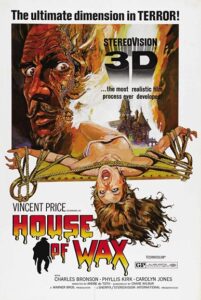
Twenty years after “The Mystery of the Wax Museum”, Warner Bros. produced a remake. The film’s director was Andre de Toth, who was asked to make a 3D film here: although he can’t watch 3D films because he lost an eye at a very young age. 1953’s “House of Wax” is considered the first 3D film with stereophonic sound in a regular movie theater and the first 3D color film from a major American studio.
Here’s the theatrical trailer for “House of Wax,” from the days when trailers didn’t necessarily show scenes from the movie but didn’t spoil them.
The “House of Wax” is considered “culturally, historically, and aesthetically significant,” as the United States Library of Congress put it, and it has been shown in theaters over the decades since in several variations (among others, as part of the 3D movie explosion in the 1980s). The plot here resembles the “Mystery of the Wax Museum”. In the lead role, Vincent Price plays the wax artist who manages to survive a fire, stays alive in a distorted image and attempts to restore his wax museum with a murderous touch that you’ve probably already guessed. Despite the director’s difficulties, the film featured impressive 3D scenes for the time, where viewers saw before their eyes a ping-pong ball, can-can dancers and a figure quickly emerging towards them.
Although early reviews of the film ranged from mediocre to negative, in part due to unwarranted brutality or limited use of 3D, over the years it gained cult status. Seventy years later, the film holds a 93% positive review rating among critics on Rotten Tomatoes and a commanding 7.0 rating on IMDB, which is known to be quite rare in the horror genre.

Wax Work (1988)
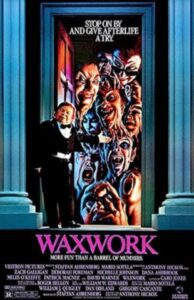
Before tackling the latest film “House of Wax”, you should take a quick stop in the 80s. In 1988 the film “WaxWork” was released, a horror comedy by Anthony Hickox (who directed the third film in the “Waxer of the Underworld” series) about a director of a wax museum who uses his works “to release horror into the world.” A group of young people arrive at a strange wax museum and pass into another dimension, where the wax sculptures aren’t exactly sculptures. We haven’t seen this movie yet, but from the description and trailer it looks like a horror fan’s delight with plenty of humor, gore, and a reflexive awareness of the genre we all love.
The film is loosely based on “WaxWorks”, a 1924 German silent film, rather than the other films we’ve reviewed here.
House of Wax (2005)

We mentioned “WaxWork” for an apparent reason: the plot of 2005’s “House of Wax” combines elements of both “House of Wax” films and this film to some extent, so you could say it’s kind of a loose combination of the two. Do you need clarification? So do we, but we’ve already gotten used to the fact that horror films are almost always based on previous films in one way or another.
In “House of Wax,” directed by Spanish director Jaume Collet-Serra (“Orphan,” “Jungle Cruise,” “Black Adam”), we meet a group of friends going to a soccer match. She decides to stop for the night in the middle of a deserted forest (in horror movies, this makes a lot of sense), meets a mysterious man, and discovers the next day that the car won’t start (this is also all too common in horror movies). Some members of the gang decide to go to an abandoned town, where there is practically nothing except what was once the “Wax Museum House”, which houses wax sculptures that are a little too real. From this moment on, the young people will fight for their lives against crazy brothers who want to brutally kill them and add them to the museum’s collection.
The truth is that this film has a lot of things that need to be improved, such as the atmosphere, the plot, the storyline and the acting of some characters, which explains the low reviews it received. Critics also disliked the fact that it deviated too much in nature and style from previous versions of “House of Wax.” At the box office, the film was reasonably successful, grossing around $70 million worldwide, which is less impressive when you consider that the film’s budget was around $40 million.
Nonetheless, some see “House of Wax” as a must-see film for horror fans; some even speak of a cult film. For the author of these lines, it’s a kind of “guilty pleasure” – and not just the pleasure of seeing Paris Hilton, this time in a legitimate and not reserved for adults film, impaled to death. This brief murder scene created much of the buzz around the film, as is made clear by one of the film’s marketing advertisements which invited viewers to “watch Paris die.” It also went pretty viral, but not to the extent of an hour-plus sex tape (not sure why we thought of that comparison).
The film included more or less strange deaths of the secondary characters, mostly wax and stabbing of one sort or another, and some pretty good scares. And of course, it’s impossible not to mention Elisha Cuthbert, who was at the time a sex symbol and a sort of hit girl who has almost disappeared in recent decades.

Will the House of Wax reopen?
Over the years, several attempts have been made to revive the House of Wax films, which have been around since the beginning of commercial cinema. For example, Tim Burton wanted to produce another version of House of Wax, this time a musical. Burton had planned that this version would feature Michael Jackson – we weren’t sure if it was a human figure or a wax figure – although, according to reports, Jackson himself was eager to participate in the project. Burton’s idea was unfortunately ultimately rejected by the studios.
And what about “House Of Wax 2?” » Well, no, so quickly! The writers of the 2005 version, Carey W. and Chad Hayes, have stated that they are not working on a sequel. They had the idea of a prequel (prequel film) but were rejected by the studios because “House of Wax” was not exceptionally successful at the box office. We believe that we will not close the door on wax houses and that we will still see people murdered to become dolls or resurrected wax dolls. Even if that doesn’t happen, we’ll still have Madame Tussauds and other small wax museums (like the one in Barcelona), body displays, and other attractions.
Do you want to have a complete Wax experience? Try one of these Was museums!